You don't need another program. You need a network.
Rip Off and Duplicate
One of the Mega Trends described in my last email — the Future Ready Five Mega Trends Short Shot — is the overarching trend away from hierarchies and toward decentralized networks. One of the examples I gave was that, 50 years ago, we tended to assume that government agencies would be the first line of defense in meeting the needs of our communities. Of couse, that has changed over time, as budget cuts and distrust in government has shifted a very large amount of that responsibility to thousands of nonprofits, activist groups, church programs, etc.
Like most decentralized network systems, there are some potential benefits, at least in theory if not always in practice. Such organizations can acess local resources that national operators might miss, they can leverage more volunteer hours, and they can often build trusting relationships with the specific people they are trying to serve, which is much harder for a state or federal agency to do.
But one of the problems that I see over and over again, in communities of all sizes and demographics, is that we becomes overwhelmed with small, well-intentioned but disconnected initiatives. Instead of trying to work with others, people who want to solve a problem too often jump into creating a whole new organization or initiative, missing the opportunity to learn from and collaborate with others who have compatible objectives. Everyone assumes that they have to be a cowboy, but even the cowboys understood that they had to work together to get thousand-head herds to market.
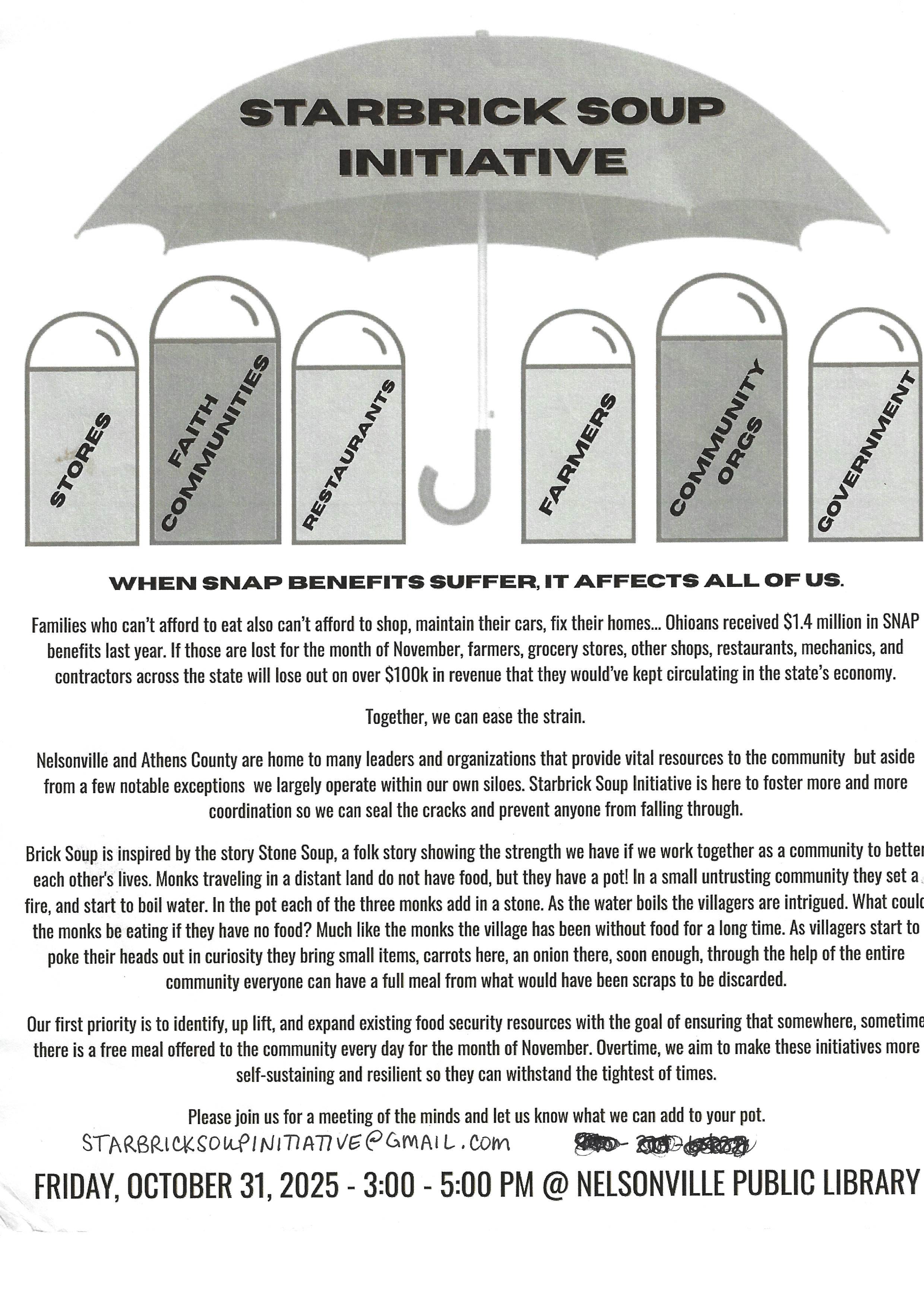
This small effort from a rural Ohio community gives us a great example of how our nice but atomized efforts often fail, and what it takes to overcome those failures. As the loss of SNAP funds due to the government shutdown loomed in late October, a group of 20- and 30-somethings in one town realized that many more of the people at risk of going hungry could be fed — IF the organizations in the community actually coordinated their schedules. As they told me, there are enough churches and service organizations providing food that a lot of the people at risk could get means every day…except that a lot of them held their meals or food pantries on the same days. That means that some days, people in need may have three or four options, and on other days they have none.
This initiative (named for a famous symbol of the community) proposed a radical idea: How about if the organizations that want to help get together and coordinate their schedules so that every day is covered? How about a shared calendar that helps people in need know where they can go when for what assistance, instead of hoping, guessing wrong, or going without?
I don’t know yet whether the organizations have responded to this insight. But it’s simple, and also brilliant.
In the Industrial Era, we learned to work in separate silos, walling ourselves off from others. Whether they intended to or not, that’s what these organizations, and thousands of others like them, do — they default to assumption that what happens outside your gates isn’t your business. But if we’re relying on a decentalized network of small operators — for speed, responsiveness, local ownership and more — then we also need to learn to coordinate them.
Instead of a scattering of those old thousand points of light, we need something more like a drone show — a coordinated, synchronized collection that can do more than its bits can do alone.
Here’s the flyer. Would this make a difference in your community? Let me know.